Wednesday, 15 October 2014

No Ebola in Ogun State, Soyinka


Ogun State Commissioner for Health, Dr Olaokun Soyinka has debunked rumours making the rounds about Ebola Virus in the State.

In a statement made available to Journalists, Dr Soyinka described the rumour as false in its entirety, calling it "total misinformation."

He said " I want to correct and set the records straight concerning some misinformation regarding a case that was reported to the Ogun State Ministry of Health early on Tuesday October 14 concerning a male patient admitted to an Ijebu Ode Hospital.

"On receipt of the information, our rapid response team was dispatched to investigate and the patient was rapidly given the all clear. He is a known peptic ulcer patient who had some bleeding and also tested positive for malaria. He has been treated and his symptoms are resolving."

Dr Soyinka who commended the private hospital concerned, said they acted responsibly in reporting to the authorities.

" We investigate such cases on a regular basis, and most often once assessment is completed, the all clear is given without raising fears and causing unnecessary public concern."

He stressed that in line with best practices, and as ably demonstrated by Lagos State recently, full disclosure remains the best protection against spread of the virus, adding that information needs to be made public and will be done so immediately and fully.

"In this case there is absolutely no cause for alarm," He added.

The Commissioner also assured citizens of Ogun State that the Governor, Senator Ibikunle Amosun CON,FCA has facilitated all necessary precautions and has ensured that the State health authorities are able to remain on full alert, even as the epidemic continues in West Africa.

Signed
Dr Olaokun Soyinka,
Commissioner for Health,
Ogun State

Monday, 13 October 2014

Timi Dakolo; The King of Soul and His Great Nation


By Jennifer Nkem-Eneanya

"Here we stand as a people

With one song: with one voice

We’re a nation: undivided and poised

We will take our stand: and build our land

With faith: to defend what we love

Here we are as a people

With one heart: for one cause

We’re determined: to rebuild and restore

Where freedom reigns: and truth prevails

A land where there’s hope for us all (2x)

(Chorus)

We’re all we have, we’ll defend our land

We believe in this nation, and we know we’ll get there

We’re all we have, we’ll defend our land

We believe in Nigeria and the promise she holds

And that one day we’ll shine like the sun

We’re a great nation”

The chords and soul from which this and other great pieces pour forth is none other than the now legendary Timi ‘the Voice’ Dakolo.

Born on 20, January 1981 in Accra, Ghana to a Nigerian father and a Ghanaian mother, the native of Bayelsa State, Nigeria lost his mother as a young teenager and was raised by his Grandmother in Port Harcourt, Rivers State.

Music came naturally to the young Timi and he burnished his talent with stints in the church choir and even co-founded a singing group- Purple Love- in Port Harcourt. Therein he might have remained- although with his vocal capabilities that would most likely not have been the case- when the West Africa Idols Singing reality show opened for auditions in 2007.

He reportedly wowed the judges during his performance and immediately became a favourite across the nation. At the finale, he emerged victorious, battling off a horde of equally strong contenders including ‘If You Ask Me’ crooner Omawumi Megbele and Jodie of the ‘Oh Baby’ fame.

Unfortunately, the promised recording contract- the prize- fell through and it seemed as though Timi had faded into oblivion. Tongues wagged and people, yours truly included wondered, ‘Whatever happened to that fellow with the powerful tenor?’

Needless to say, a powerful comeback re-assured West Africa that it had voted wisely during the competition. Despite his disappointments and flailing around the music industry trying to find his footing, the resurrected Timi was self-assured, mature, unapologetic and unfazed by the fact the he seemed to have lagged behind in the race to stardom.

In 2011, Timi released his debut album, ‘Beautiful Noise’ a great collection of love songs, and ballads to great acclaim. The bulk of the album was produced by Cobhams Asuquo with audience favourites like ‘So beautiful’, ‘Love song’ and ‘There’s a cry’. Earlier, he had released a single, ‘Heaven Please’ a tribute his late Grandmother. The song featured rap from M.I and won the Best  Recording at the Hip Hop World Awards (now Headies).

Other hits have followed, including Great Nation in 2012, and most recently, a stirring love song, ‘Iyawo Mi’ [My Wife] guaranteed to make even the coldest heart melt and fall in love. He is presently working on his sophomore album ‘Love and Consequences’; what can we say? The man loves to love! Need I add that he is ecstatically married to the love of his life Busola and they are blessed with a bundle of three!

Timi is a constant presence at highly rated Shows and Concerts, including those organised at the very highest echelons by the nation’s presidency. Such is the pull and power of his music and his performance. Those slow, uncertain days? Gone with the wind I am sure!

In an interview with YNaija! Magazine, Timi stated, “The reason I am doing music is not because of instant money or fame; I want to be here a long time, evergreen…I look at Onyeka Onwenu, I look at King Sunny Ade and I want what they have…”


Acknowledgment: Jennifer Nkem-Eneanya, http://www.konnectafrica.net/timi-dakolo/

Excerpts : Tun Henry

BUHARI’S PRESIDENTIAL BID GATHERS MOMENTUM FROM LAGOS


The Presidential bid of the All Progressives Congress chieftain, Major-General Mahammadu Buhari gathered momentum in Lagos Sunday as he paid a visit to the State Governor, Mr. Babatunde Fashola SAN, to deliver a special invitation to the formal declaration of his intention to contest the nation’s 2015 Presidential Election.

Gen. Buhari, who arrived the Lagos House, Marina, in company with members of his Team, said he decided to convey the invitation personally because Lagos is the biggest and most viable constituency of the APC adding that he would also do same to all the other Governors in the Southwest.

According to the APC Chieftain, who was national leader and Presidential Candidate of the Congress for Progressive Change (CPC) in 2011, he would also visit Oyo and Kwara States and go round to the other States before Wednesday, which according to him, is the D-Day.

In his short remarks, Governor Fashola thanked the retired General for the honour of delivering the invitation himself. He prayed that God would honour the APC Chieftain in his bid and grant him the grace to realize his ambition.

He declared, “Let me say that we are pleased to receive you. We feel honoured by your presence and God will honour you and His grace will continuously be sufficient for you in the undertaking that you are about to commit to”.

Also present at the occasion were Lagos State Commissioners for Agriculture and Cooperatives, Prince Gbolahan Lawal; Local Government and Chieftaincy Affairs, Mr. Ademorin Kuye; Rural Development, Mr. Cornelius Ojelabi and Special Adviser, Youth, Sports and Social development, Dr. Dolapo Badru. On the team of Maj-General Buhari were former Speaker, House of Representatives, Alhaji Aminu Bello Masari, former Governor of Bayelsa State, Mr. Timipre Silva and former Minister of the Federal Capital territory, Mallam Nasir El-Rufai among others.

Saturday, 11 October 2014

Nigeria Has Successfully Contained Ebola, US Hopes To Learn From Their Response


By Huffington Post

Africa’s most populous country has reason to celebrate.

According to Nigeria’s health ministry, the West African country has officially claimed control over the Ebola outbreak ravaging nearby nations, USA Today reported. No new cases of the virus have been reported since Aug. 31. Nigeria’s “extensive response to a single case of Ebola shows that control is possible with rapid, focused interventions,” Tom Frieden, director of the Centers for Disease Control and Prevention (CDC), told the news source.

According to information from the CDC updated on Oct. 7, Nigeria has been downgraded to a Level 1 watch by the organization because of the decreased risk of Ebola transmission.

Nigeria’s success has grabbed attention from U.S. officials hoping to prevent transmission of the virus in America, after Liberian Thomas Eric Duncan was diagnosed with Ebola in Dallas. On Wednesday, Duncan, 42, died at Texas Health Presbyterian Hospital. The CDC is sending researchers to Lagos, Nigeria’s largest city, to study how the country was able to control the disease.

The Guardian reported that the ongoing struggle to eradicate polio in Nigeria — recently complicated by Boko Haram’s insurgency — actually helped the country in thwarting Ebola. The Bill & Melinda Gates Foundation built an emergency command center in 2012 to survey the presence of polio in the region, and the existing system helped enable the country to proactively contain the spread of Ebola.

Utilizing emergency operations, healthcare personnel in Nigeria had confirmed 19 cases of Ebola, as well as one probable case, Reuters reported. By Sept. 24, officials had identified 894 contacts with those cases and conducted 18,500 visits with those who’d potentially been infected to check for Ebola symptoms. In the weeks since, no new cases have emerged.

But while Nigeria is heaving a sigh of relief, transmission of the virus continues in the hardest-hit West African nations of Guinea, Liberia and Sierra Leone. According to the World Health Organization’s latest report, there have been 3,865 deaths and 8,033 total cases worldwide to date.

Text : Huffington Post
Photo Choice: Tun Images
Photo Source: Google Images

http://www.huffingtonpost.com/2014/10/09/nigeria-contains-ebola-outbreak_n_5959442.html

JOKE SILVA - A SHORT BIOGRAPHY


Joke Silva is a prolific Nigerian actress and director. She was born on the 29th of September, 1961 and has featured in over 300 Nigerian movies and home videos. She is most popular for movies like Phone Swap, The Secret Laughter of Women and Last Wedding and also as one of the Judges on the MTN Project Fame TV Series. 

GROWING UP 
Joke was born in Lagos, Nigeria, the second child in a family of five children and she spent most of her early days in Lagos. She attended Holy Child College in Lagos for her secondary school education after which she proceeded to study English at the University of Lagos. After her tertiary education in Lagos, she then moved to England where she attended Wentworth Milton, Mount Bournemouth to obtain her A levels and after that, she went ahead to study drama at the Webber Douglas Academy of Dramatic Art in London. 

ACTING CAREER 
Joke Silva started acting in 1981 and had her first appearance was in an English movie titled “Mind Bending” in 1990. In 1993, she featured in a Yoruba movie titled “Owurolojo” after that. Joke has featured in several films and television series including Secret Laughter of Women, 30 Days, Letters to a Stranger and Widow’s Cot. She also starred in two critically acclaimed movies that earned Africa Movie Academy Award-nominations, White Waters and Amazing Grace. During her days at the University of Lagos, she belonged to a cultural group which comprised of the likes of Bode Osanyin, Stella Monye and others.

FAMILY AND PERSONAL LIFE 
Mrs Joke Silva who hails from Isale-eko (Lagos Island), is married to veteran Nollywood actor Olu Jacobs and the union is blessed with 2 children. They have been married since 1985. Together, they both run the Lufodo Group, which houses Lufodo productions, Lufodo Academy of Performing Arts, Lufodo Consult, and Lufodo Distribution. She serves in the capacity of Director of Studies at the Academy. 

AWARDS AND ACHIEVEMENTS 
She has received several awards and nominations for her work as an actress including the awards for Best Actress in a Leading Role at the 2nd Africa Movie Academy Awards in 2006 for the movie, Women’s Cot. She won the award for Best Supporting Actress for her role in the movie ‘White Waters’ at the 4th Africa Movie Academy Awards in 2008. She has also received the EMOTAN Award by African Independent Television (AIT) and the SOLIDRA Award for Visual Art. She has also curated for the Bank of Industry (BOI) in Theatre, Film, Documentary and Poetry and also for the 2012 London Olympics. To crown it all, this year(2014), she received a national award,Member of the Order of Niger (MON)

Acknowledgement : Dee Apphiaanna 

GOD LOVES NIGERIA BY FEMI FANI KAYODE


God loves Nigeria so much. For those that doubt it kindly consider the following.

They created ebola in their demonic labs for bio weapons. They sent the disease to our shores through an insane Liberian but the Lord defended us and refused to allow it to take root in our shores.

The watchers prayed "return to sender" and ebola was sent back to Dallas through another insane Liberian. Now they seek to learn lessons from the Nigeria that they targetted and sought to destroy about how to "contain ebola".

God loves Nigeria so much. Why? Because, as the bible says, ''He uses the foolish things of this world to confound the wisdom of the wise''. For those that still doubt it kindly consider the following.

They refused to label Boko Haram as a terrorist organisation until all men of goodwill begged them to do so and until the terrorists had slaughtered no less than 25,000 Nigerians, including innocent children whilst abducting thousands more.

They refused to sell us arms to fight the Haramites and when we approached other nations to do so they directed them to say ''no'' and turn us down.

Yet God was with us, we sourced those arms ourselves and ever since then the tied has turned and our gallant soldiers are winning the war against Boko Haram.

Can all this be just coincidence? Do these so-called friends and allies of our nation really wish us well?

I read the response of the American Ambassador to Nigeria about our concerns about the US arms embargo on Nigeria. He spoke nothing but nonsensical popycock and bunkum.

What on earth have we done to them that they seek to bring us to our knees and decimate our country with terror, torment, violent brutality and disease?

Why have they visited us with so much covert hate despite our obnoxious fawning and desperate crawling before their superpower thrones for the last one hundred years?

Have we not played the fool enough for them and have we not bowed low enough to them on bended knee for the last 54 years?

Yet despite all our efforts to please our international partners and modern-day slave masters they seek to effect their prophecy that chaos must envelop Nigeria and that our country must break up by 2015.

They seek to ensure that we are enveloped in a sea of carnage and fratricidal butchery the likes of which have never been seen before on the African continent or indeed in world history.

In the light of all these observations numerous questions must be asked? Who is really behind Boko Haram and how come they have more sophisticated arms than the Nigerian military?

Who supplies them with those arms and all that training? Is it the same forces that covertly trained, armed and supplied ISIS, Al Nusra and Daesh?

Is it the same powers that used those barbaric terrorist organisations in Syria to attempt to topple President Bashar Al Assad and in Iraq to push Nouri Al Malaki out of power?

Is it the same forces that unleashed mayhem and created turmoil in the Ukraine and that sought to plunge Europe and Russia into a bloody war?

Is it the same forces that created Al Qaeda and commissioned Osama Bin Ladin to push the Soviets out of Afghanistan? Is it the same people that seek to use Boko Haram to decimate our country, destroy our people and bring our government to it's knees?

It is very clear to me that NATO will deploy ground troops to Iraq and Syria relatively soon. This was the plan all along. The long-term objective is not just to destroy and defeat ISIL but also to remove Bashar Al Assad from power in Syria.

As a matter of fact the latter has always been the primary objective and America, Turkey, Saudi Arabia, Qatar and a handful of others in the Arab Gulf states supported and funded ISIS, Al Nusra, Daesh and a number of other terrorist groups specifically for that purpose for a number of years.

The sheer evil and horror of ISIS has provided a useful pretext and justification for a full scale invasion of Syria and Iraq by the western powers and their sunni Arab allies.

That invasion, which will be clothed in the name of ''liberation'', will come soon. Bashar Al Assad, Syria, Russia, Iran, China and their secularist allies in the region need to brace up and prepare for the worst. This is indeed a rhapsody of reality.

Yet whoever unleashed these forces and whatever their evil intentions for Nigeria are, one thing is clear: despite all our complexities, self-hate, self-doubt, ignorance, naivety, eccentricities and innocent trusting ways, God loves us dearly and we shall not go the way of Iraq, Syria or Libya.

After all this is the land of the Ameyo Adadevoh's and other brave souls. This is the land where the watchers pray through the night and stand in the gap for their beloved nation and their compatriots regardless of faith, tribe or creed.

This is the land where, though we pretend to hate one another and we bicker morning, night and day, we know the meaning of the word patriotism, honor, dedication, resilience, ruggedness and love.

This is the land whose people know how to worship and praise the one true God and who call on His name night and day.

The earthly powers that be and the emissaries of the devil, no matter how powerful, how rich and how connected will never destroy us and neither shall the counsel of satan prevail in our land.

Each time they throw a bomb at us, like ebola, it shall ''return to sender''.

Each time they refuse to sell us arms to enable us to defend our people and redeem our honor the Lord shall raise others who shall do it in their stead.

The bottom line is as follows: you may hate us and seek to shame and humiliate us but God loves Nigeria and His purpose for our nation, whether you like it or not, shall surely come to pass.

God bless Nigeria and may He continue to deliver us from our enemies, preserve our unity, defend our shores and protect our borders.


Chief Femi Fani Kayode is a Nigerian politician, essayist, poet and lawyer. He is a member of the ruling Peoples Democratic Party (PDP). He was the Special Assistant (Public Affairs) to President Olusegun Obasanjo from July 2003 until June 2006. He was appointed the Minister of Culture and Tourism of the Federal Republic of Nigeria from 22 June to 7 November 2006 and as the Minister of Aviation from 7 November 2006 to 29 May 2007.

Friday, 10 October 2014

Okonjo-Iweala Bags African Finance Minister Of The Year Award


The Minister of Finance, Dr Ngozi Okonjo-Iweala, on Friday bagged the African Finance Minister of the year award for her outstanding performance as a finance minister.

The award was presented to her by the African Investor Magazine on the sideline of the ongoing annual meetings of the World Bank and the International Monetary Fund (IMF) in Washington DC.

She thanked the organisers for the award and described it as an absolute honour and auspicious.

She called on all investors in Africa to join the fight against the deadly Ebola virus disease that is ravaging some countries in West Africa.

“What is happening in Liberia, Guinea and Sierra-Leone and the success we had in Nigeria and Senegal in containing this virus should not be allowed to set Africa back.

“You as private sector and friends of Africa need to send the message that we should not be so afraid of Ebola that we stigmatise the whole continent.

“I think that it is only with your own leadership, as African investors, that the rest of the world can see which way they should pass. So, I am really urging you to be ambassadors to the continent,” she said.

Okonjo-Iweala said that in spite of the challenges facing the continent, African leaders should sustain the successes recorded in the past.

These challenges, she said, include infrastructure, governance, poor education system, employment, corruption, among others.

“We are not shying away from these challenges but the turning point now is that we are in the continent where we have the political will and confidence to tackle these challenges.

“I think that we as Africans must always take the lead because if we don’t solve our problems, nobody can do it for us.”

Okonjo-Iweala called for continuous partnership with the private sector, donor agencies and non-governmental organisations. 

Acknowledgement: NAN, Leadership


Meet International Celebrities You Did Not Know Are Nigerians


Ositadimma Umenyiora (Nfl Player)

Osi is a British- American football player born on November 16, 1981 to Nigerian parents.

The award winning football player he is one of three British-born players to have won a Super Bowl ring. Osi is an outside linebacker for the Atlanta Falcons of the National Football League (NFL).

In July 2014,Osi Umenyiora got married to Miss Universe 2011, Leila Lopes .

Lemar Obika

English R&B singer and song-writer, Lemar Obika, born 4 April 1978 to Nigerian parents of Enugu State. The award winning Lemar, although much hasn’t been heard of him of recent released hit songs like Time to Grow, If There’s Any Justice”. He rose to fame following his position in the third place on the first series of British talent show Fame Academy.

Uzo Aduba

Hollywood actress, Uzo Aduba is born to a Nigerian parents. She is popular for her role in the hit series ‘Orange Is The New Black’. Recently, in August 2014, Uzo Aduba won the Primetime Emmy Award for Outstanding Guest Actress in a Comedy Series in Los Angeles.

Akinnuoye-Agbaje

Akinnuoye-Agbaje was born in Islington, London. His parents are Nigerian, of Yoruba origin. He has a law degree from King’s College London and a Masters in Law from the University of London. His best known acting roles have been as the imposing convict Simon Adebisi in the 1990s HBO prison series Oz, and as Mr. Eko on ABC’s survivor drama Lost. He was also in an episode of New York Undercover. He has numerous film credits since he began acting in 1994 and has appeared in many top films, including The Bourne Identity, in which he played a deposed African dictator, Hitu the police officer in Ace Ventura: When Nature Calls, Lock-Nah in The Mummy Returns, and Heavy Duty in G.I. Joe: The Rise of Cobra.

Adewale is also a fashion model, writer, director, producer

Ashley Madekwe (English actress)

She is an English actress born to a Nigerian father and English mother. Ashley is popularly known for her role in the ABC drama series ‘Revenge’.

She is married to English actor, Iddo Goldberg

Henry Olusegun Olumide Adelo Samuel

Seal real names Henry Olusegun Olumide Adelo Samuel is a British singer and songwriter.

Born on February 19, 1963 to Nigerian father, Francis Samuel and mother, Adebisi Ogundeji. He was married to model/TV personality, Heidi Klum for seven years with three kids together before they got separated in 2012. The award winning R n B singer has won four Grammy Awards and an MTV Video Music Award amongst others. Seal has several hit songs which include ‘Kiss from the rose’, ‘Crazy, ‘Killer’, “Lips Like Sugar”.

Shirley Bassey (Welsh singer)

She is a Welsh singer born to Nigerian father, Henry Bassey and English mother, Eliza Jane Start. Born on January 8, 1937. Shirley Bassey is well known for recording the theme songs to the James Bond films Goldfinger, Diamonds Are Forever.

One of the most popular female vocalists in Britain during her time, she was awarded Dame Commander of the Order of the British Empire (DBE) in 1999 by Queen Elizabeth II for her services to entertainment.

Tinie Tempah

Tinie Tempah real names Patrick Chukwuemeka Okogwu is one of the top UK rappers.

Born on November 7, 1988 to Nigerian parents from Ibusa, Delta state.Tinie Tempah began his music career in 2005 and he has since carved a niche for himself with several awards to his names.

From Brit Award, Nigeria Entertainment Awards to MOBO Awards. In 2014, he won the BET Awards for the Best International Act.

In 2013, Tinie Tempah travelled to his homeland, Nigeria, to play his first ever show in Lagos to thousands of fans. Apparently, Tinnie Tempah has got a thing of fashion, as he is reportedly one of the most stylish men in the music industry.

Nnamdi Asomugha

NNAMDI ASOMUGHA: Is a former American football cornerback; born on July 6, 1981 to Nigerian parents from the south-east. The football star, Asomugha is married to top American actress, Kerry Washington. They welcomed their daughter in April 2014.

For many years he was frequently mentioned as one of the best shutdown corners in the National Football League. Meanwhile aside being a football player, Nnamdi is also an actor.

Sophie Okonedo (British actress)

Sophie is a British actress born to Nigerian father, Henry Okonedo and a Jewish mother, Joan nee Allman. Popularly known for her role in top movies such as After Earth, Hotel Rwanda. She also acted in the TV series ‘Doctor Who’.

In 1991, she made her acting debut in the British drama, Young Soul Rebels. The Award winning actress, Sophie soaring high in her career was nominated for an Oscar. In 2010, she was awarded the OBE (Officer of the Order of the British Empire) in the 2010 Queen’s Birthday Honours List for her services to drama.

Sophie, a graduate of Cambridge University is single mother of one.

Hugo Weaving ( Australian-British actor)

Australian-British actor, Hugo Weaving was born on April 4, 1960 in Nigeria.

Although not to Nigerian parents but he was actually given birth to in Nigeria, which makes him a Nigerian by birth. The 54-year-old old Hugo Weaving was born at the University College Hospital in Ibadan.

The award winning actor has acted in several blockbusters movies the likes of, The Matrix Trilogy and Lord of The Rings Trilogy, Transformers Trilogy, The Hobbit Trilogy and Captain America.

Chiwetel Ejiofor

Chiwetel Ejiofor was born on July 10, 1977 to Nigerian father, Arinze and mother, Obiajulu.

His father was a doctor and mother, a pharmacist while his younger sister is CNN correspondent Zain Asher. Chiwetel who has starred in top movies the likes of ’12 Years A Slave’, Half of a Yellow sun’ amongst others was awarded the O.B.E. (Officer of the Order of the British Empire) in the 2008 Queen’s Birthday Honors List for his services to drama. He became more popular for his role as a slave in the movie “12 Years A Slave”, receiving the BAFA male acting trophy.

Acknowledgement: Leadership
Original Source quoted by Leadership: Naija Pals


Durbar: Prestigious Heritage Of Ancient Kanem-Borno People


In Northern Nigeria, when horses are not used for the traditional purpose of transportation but marched out in studs for the sake of fun and entertainment, that procession is called a durbar.

Though horses are customarily used for durbar, folks in other climes also use camels or llamas for similar entertainment.

The durbar is not a festival, as many people see it. Rather, it is a classical form of traditional entertainment, mostly carried out by kings’ horsemen to show off the eminence and grandeur of their monarch and kingdom.

In the past, in Northern Nigeria, when kings and emirs ruled with executive or full monarchical powers and responsibilities, a durbar of armed horsemen cladd in majestic regalia were usually put up as escorts or guards for their emir. They display their strength, horsemanship, loyalty and readiness to go to the war for their ruler.

Today, as the traditional monarchs no longer go to war for territorial conquests, the durbar has now become a form of entertainment by the same kings’ men. But these days, it is an avenue to display two things; horsemanship and loyalty to the rulers.

The ancient Kanem-Bornu Empire, which formed part of the present North-eastern states of Borno and Yobe, are known and respected for one unique tradition – horsemanship and prowess.

Great historians have related that the people of Kanem-Bornu Empire, right from the 9th Century, were not only great nomads, warlords and extraordinary business merchants; they were also the first of the Central Sudan people “to acquire and make use of iron technology and horses”.

Though the ancient kingdom has, over the centuries become dismembered and butchered by geographical border redefinitions, especially towards the end of the 19th Century, its rich and enviable tradition from its past is weaved into the present.

In 1963 when Nigeria attained the status of a ‘republic’, Borno’s durbar contingent, led by Shehu Garbai ibn Elkanemi, was declared the best at a procession held in Kaduna, the then defunct capital of the defunct Northern Region of Nigeria.

“There is no gain-saying that the Kanem Bornu Empire is the nucleus of durbar in northern Nigeria. Horsemanship and durbar are the core definitions of the grandeur of the Kanem Bornu and it was after the Durbar procession in 1963 that other parts of northern Nigeria like Kano and the rest began to pick interest in promoting their culture of horsemanship,” said seasoned journalist and historian of note, Malam Ibrahim Gwamna Msheliza.

Msheliza recalled that there were times in the past when the people from the North-west would visit Borno to learn the art of dressing and adorning of horses from the Borno royal horse handlers.

In the old Borno State, horsemen from Gaidam and Machina (in present-day Yobe State) were ranked the best amongst all.

It was also learned that the fortune of the present Borno began to decline slightly in this respect after the creation of Yobe State in 1991.

After the creation of Yobe State, local government areas like Machina and Gaidam moved out of Borno. As such, the glory of the durbar shifted to the sister state, Yobe.

The then district head of Gaidam was Kaigama Zubairu (the title kaigama stands for ‘warlord who leads the royal troops’). That, perhaps, was the reason behind the near-superlative horse-riding skill of the Gaidam and Machina people.

Machina local government area of Yobe State now ranks the best in Nigeria, in terms of horsemanship.

Machina was the durbar champion at the 2008 and 2009 editions of the annual Abuja Carnival.

History has revealed that Machina was once under Gaidam local government area before it became an autonomous local government in 1991.

Machina Did Not Attain Its Stallion Pride Out Of The Void

In the pre-colonial days when the shehus were fully in charge of the administration of their domains, Machina Town was like the defense headquarters of the Kanem-Bornu Empire. The kaigama, who is usually the district head of Gaidam, was equal to the minister of defence.

“Due to its friendly topography, suitable for the breeding and managing of horses, Machina’s famous Gumsi forest was like a depot for all the war horses of Kanem-Bornu. Thousands of horses – both war-tested and the ‘newly broken’ ones being trained in the art of warfare – were kept in the Gumsi Forest where there was enough water and feeds for them all season,” said a member of the royal family in Borno, Malam Yerima Maina Modu.

In those days, if Kanem Bornu was to wage war against any of its many enemies or defend a certain part of its territory, the kaigama (minister of defence) would have to deploy thousands of horses for the troops all the way from the Gumsi Forest at the behest of the shehu.

Till this day, Gumsi forest remains the largest breeding ground of choice horses in the whole of Nigeria and, even up to surrounding countries like Chad and Niger.

“Horsemen from Machina will, forever, remain the best and Kanem-Bornu can never be second fiddle when it comes to the contest for supremacy in horsemanship or durbar,” opined horse enthusiast Alhaji Zanna Goni.

The Shehu of Borno, His Royal Highness, Abubakar Garbai Al-amin Elkanemi, revealed during a news interview in 2009, shortly after his ascension to the exalted throne, that one of his foremost dreams was to reinvigorate the culture of the durbar, which is all about procession of horse-riding for the purpose of entertainment during Eid celebrations or in honour of positive developments or very important visitors to his kingdom.

“I love horses and it is my desire to acquire at least 100 of my own, because it is not only our tradition but our pride as a people,” he had said.

The foremost monarch of Borno said his desire was to, personally, own at least 100 horses in his royal stable, while he will encourage every district and village heads to possess, at least, 25 to 15 horses of their own, accordingly.

The Shehu recalled times in history when, as a boy, his father, then the Shehu of Borno, mounted him on one of the horses of the horse riders who was part of the procession to welcome the late Ethiopian ruler, Emperor Haile Selassie, in the year 1966.

“I rode on the horse during that event, because the horse riders from Borno state were invited to welcome the Emperor with a grand durbar, which he obviously cherished,” said El-Kanemi.

With horse-riders dressed in flambouyant, overflowing regalia and horses resplendent in embroidered seats and muzzles, the durbar procession is usually colourful.

During festivities like Eid ul Fitr, Eid ul Kabir, Independence day celebrations or events like the coronation of a new emir, the swearing in of governors or during the visit of a president, durbar is usually a peculiar show to mark such occasions.

On occasions like the eid celebrations, durbar is usually the icing on the cake.

When the durbar is to hold, horses and men are deployed to file out in their thousands, to witness the pride of tradition.

The joy of the people reaches a crescendo when their monarch mounts his horse and leads the procession of elegantly dressed horses.

In Borno Emirate, for example, no eid celebration is worth remembering if the durbar celebration does not accompany it. The memorable moment of every eid celebration is for the people to see their monarch mounted on his royal stallion, leading a galloping procession of his council chiefs and vicegerents, amid clouds of dusts and pounding hoofs.

Though the durbar has now become a symbolic show and occasional entertainment, its umbilical cord is still tethered to royalty.

No one convenes a durbar without the express consent of the shehu, emir or the district heads, as the case may be.

“Durbar still remains the prerogative of the royals, because it all began with them,” said a prince of the emirate, Abba Ali.

http://leadership.ng/entertainment/life-and-culture/386582/durbar-prestigious-heritage-ancient-kanem-borno-people
Acknowledgement: Leadership
Photo Choice: Tun Images
Photo Source: Google Images

Thursday, 9 October 2014

FASHOLA EXPLAINS IDEA BEHIND OCTOBER 15, HORN- FREE DAY AS LAGOS HOLDS FIRST DRIVERS’ APPRECIATION DAY


It is for our own good, it is for our own health, it is for our own life, he says.

Lagos State Governor, Mr. Babatunde Fashola SAN, Thursday threw more light on the idea behind his administration’s innovative initiative, “A Day Without Horn In Lagos” coming up on October 15, 2014, describing it as a step towards sensitizing residents to the harmful effects of noise pollution.

Speaking at the State’s first “Lagos Drivers’ Appreciation Day” held at the Lagos Chamber of Commerce and Industry House, Alausa, Ikeja, venue of the event, Governor Fashola said the Horn free day was an initiative of his administration to persuade citizens that there is a better way to live than indulging in noise pollution which has been found to be harmful to their health.

The Governor said in pursuance of the efforts to reduce environmental pollution in the State his administration has thought up the initiative meant to sensitize Lagos residents to the dangers caused by noise pollution to their health and that of their neighbours and family members.

Re-enforcing the remarks of the Guest Lecturer who put the harmful noise level at 70 decibels and above, the Governor said there is need to come down significantly because according to the global standard for measuring noise, “90 decibels is rather too high and harmful to human health”.

“It is for our own good, it is for our own health, it is for our own life. It is not because Governor Fashola said so. It is not because Lagos State Government said so. It is simply because it is good for us. Doctors have told us it is for our own ultimate good”, the Governor said.

According to him, “What we see in a way that we now choose to live is that because we live in a very noisy environment, which we can really diminish, we tend to be very noisy ourselves. We speak at the top of our voices, we play music at very high decibels and we do very many things at very high levels”.

The Governor pointed out that the campaign against noise pollution was a response to the petitions and complaints of “citizens and tax payers who, on daily basis, write and petition us that somebody is preventing them from sleep either from the noise they are making or from other uncharitable activities they are carrying on without regard for the wellbeing of their neighbours”.

Governor Fashola said the gathering also came from the challenge that he posed when Lagos State hosted the National Council on Transportation about a year ago during which he observed in his speech that in some other parts of the world, one could spend days on their roads and would not hear any noise.

He further recalled, “Occasionally, when you hear a siren you know something has gone wrong in that system; you know that either an ambulance is on its way to an emergency or firemen are on their way to a fire or policemen are tracking and chasing criminals; and I said then that why should we be different, are we not Nigerians?”.

Saying that such a change should start from Lagos “the Centre of Excellence”, Governor Fashola expressed joy that the Ministry of Transportation and all her affiliated agencies, the Drivers’ Institutes, the Transport and the Law Enforcement Institutes, have all taken the challenge up to the level of implementation.

He declared, “We are gathered here today to sensitize ourselves in preparation for the day we have chosen as a Horn-Free Day; the No-Noise day or whatever you chose to call it, but let us just bring down the noise in our society. On that day we will not be gathering like this. Each one of us and all of us will be consciously doing something to start this very exciting journey in order to reduce noise in our society”.

Thanking the Guest Lecturer for her “very informative presentation” about the adverse effect of noise on the quality of life of human beings, on their well-being and on their health, Governor Fashola said reduction in noise pollution would clearly bring about “better life, a healthier life and a more prosperous life”.

The Governor charged the audience, “I want you to remember as we leave here today that starting from the 15th of October, whether we reduce noise or not starts from you and I. If you and I make the commitment to do something positive in order to reduce noise, clearly you and I will benefit”.

He also thanked members of BE ROAD FRIENDLY CLUB who, he said “have continued to be our champions of very excellent traffic behaviour”, adding, ”It shows that our transport advocacy is not only to the elderly but we have gone to the schools and many of our schools now have this club. So we are catching them from the very beginning and exposing them to the very best culture of road traffic use and public transportation etiquette”.

Governor Fashola, who expressed confidence that the initiative of Horn-Free Day, as a starting point for noise reduction in the State, would be successful, cited the response of the citizens to such initiatives as environmental sanitation which has raised the State from the label of dirty to the cleanest city in the country, the level of voluntary tax compliance in the State about which other countries now seek to learn and the cooperation and collaboration among all the citizens in the efforts which finally saw the containment of the Ebola Virus Disease in the State.

The Governor commended the drivers, especially the awardees, for their commitment to obedience of traffic regulations adding, “Your presence here today in your numbers has clearly sent a strong message of your commitment to improving our public transportation practices and processes in Lagos State”.

“We will continue to show up models of excellence like the Centre of Excellence that we are, people who understand that driving on our roads is very serious business and that it has consequences when it is done properly just as it has very serious consequences when things go wrong”, he said.

Expressing excitement in anticipation of the Horn-Free Day, Governor Fashola declared, “It is the day from which we take the first step towards a journey of very many rewards. I promise you that our lives will change for the better if we are able to do this. People that doubted our capacity have always been surprised that whenever the people of Lagos get together there is nothing that they cannot achieve”.

In her Lecture titled, “Noise Pollution Is Too Serious To Be Ignored”, the Guest Lecturer, Dr. Kubie Enitan Layeni-Adeyemo, described noise as an unwanted sound adding that if noise is not below 70 decibels it is like spending a day in a factory full of noise.

Citing such noise to include those from generators, aircraft, and even dogs, the Guest Lecturer said a research by the National Research Centre has proved that noise levels produced in different sources at different times of the day are well over the level set by the Environmental Protection Agency and that noise pollution do contribute to many health problems.

Such health problems, she said, include partial or permanent deafness, loss of concentration, nervous breakdown and other physical and psychological problems adding, “Noise pollution is excessive noise which may harm our activity or balance of human or even animal life”.

Earlier in his welcome address, the Commissioner for Transportation, Mr. Kayode Opeifa, promised that Lagos Drivers have been mobilized for 15th of October Horn-Free Day adding that all the motor parks in the State now wear banners put up by the National Union of Road Transport Workers (NURTW) and other stakeholder unions while contact has also been made with drivers’ employers within and outside the State for the occasion. He also said the Drivers’ Appreciation Day and the Horn-free Day would be an annual event.

Highlights of the event included the award of certificates to drivers from diverse organizations both private and public who successfully completed the State’s School of Traffic Safety Advocacy Programme and presentations by members of BE ROAD FRIENDLY CLUB and a drama group from the University of Lagos.

Also present at the occasion were the Deputy Governor, Hon. (Mrs.) Adejoke Orelope-Adefulire, Permanent Secretary, Ministry of Transportation, Mr. Oluseyi Coker, members of the National Union of Road Transport Workers (NURTW), members of the Lagos State Transport Management Agency (LASTMA) and other agencies of the Ministry of Transportation as well as top government functionaries.

EBOLA: NIGERIA SET TO RELEASE LOCALLY PRODUCED DRUGS, VACCINES


Indications emerged on Wednesday that the Federal Government may have resorted to local production of vaccines and drugs for the management of Ebola Virus Disease (EVD).
This is coming ahead of Thursday’s stakeholders’ meeting slated to review the current efforts that have been put in place to contain the disease.

It was learnt that the review meeting convened under the auspices of Treatment Research Group on the EVD intends to review and discuss the drug derived from bitter-kola for the management of the disease.

Two drugs, GB One and Veron are said to have been derived from bitter-kola already.
Prominent member of the TRG and former Chairman of Independent National Electoral Commission, Prof. Maurice Iwu, dropped the hint during a joint press briefing with the co-chair of the TRG, who is also the Director-General of Nigerian Institute of Medical Research, Prof. Innocent Ujah.

“That is already in the market; but that is not the issue here. If you are weight conscious, if you go to the internet, there is a particular compound that is from casenia, which is used for weight loss. But, the one we are talking about is the drug that is derived from bitter cola, two drugs there; one is called GB One, the other one is called Kola Veron,” Iwu said during the briefing on how far he has gone on the bitter-kola option for the management of the disease and preparation for the stakeholders meeting.
He added that: “Tomorrow, it will be one of those to be reviewed, and, you will be able to see how far the work has gone. And, you will be able to appreciate what remains to be done. But, much more importantly, we are not talking about cure. That is the language that is used by the lay person. We are talking about being able to treat a disease with it, being able to manage a disease, being able to reduce the mortality rate and not necessarily in terms of curing.

“But, having said that, the issue of casenia cola will be one of the compounds we will review tomorrow. And, be rest assured that as a country and as scientists, we will not shy away from being able to discuss it with our colleagues. One of the things you will be surprised with tomorrow is that it was Prof. Iwu started work, but the actual advance done so far has been from the University of Ibadan. One certain Professor who will be there will be able to tell us what they have done in the past 20 years and other steps in that direction.”

On his part, Ujah said, “We are discussing experimental vaccines in the management of EVD and to develop a national plan for self-development of medical counter measures to emerging infectious diseases, including Ebola virus. After the national response, what is now left is that we go back to our labs and our research unit and look at what will happen.”

“It has been stated clearly that we don’t want to put the cart before the horse. The essence of tomorrow’s meeting is to brainstorm and see the strategic direction that we will go, including possible vaccine production and even drugs.

“We have submitted to the Federal Government some of the candidate vaccines that the literature has provided. But, we believe that at the end of the meeting, we should have a strategic direction in this area.

“So, apart from surveillance, apart from contact tracing, we now have to go to our laboratories and begin to do some works. Funding research is capital intensive. Therefore, one of the things that we must realise from the beginning is that it is not going to be business as usual. We must have strategic funding for the research. For human capacity, Nigeria has it; I can tell you that,” he added.


Acknowledgement: Nigerian Times, Tun Telev
Source: Nigerian Times

Wednesday, 8 October 2014

Nigeria’s Most Expensive Neighbourhood.


For the religious folks paradise is in heaven. Paradise could also be a setting. In Nigeria there is place that could be given the phrase, paradise. To be precise this place is in Lagos. It is Banana Island. Officially, it is one of the most expensive square miles in the world competing with the likes of Rhodes Island in the United States and the ‘‘Millionaires Row’’ in London.

In the past few years Nigeria’s economy has grown in leaps and bounds with the cities of Lagos, Port Harcourt and Abuja recording growths in the value of landed property. In Lagos areas such as Lekki phases 1 and 2, Ikoyi, Victoria Island, on the Island have witnessed the value of land, rental properties and houses for sale shoot up astronomically. These areas are exclusive and very upscale. They are the hubs of big businesses and residencies of the rich and the mega rich. Setting up shop or living in these areas is a seal of recognition as a big player in the economy.

The rich have however gone a step further at carving a niche for themselves with the Banana Island in Lagos. Banana Island is a choice location at the South West of Ikoyi. The island is accessed via an existing road network and occupies a sand filled area of approximately 1,630,000 square metres.

The Island is zoned into 536 plots consisting of 100 closes, which serve to enhance the banana shape of the island. Plot sizes range from 1000 square metres to 4000 square metres. The island is designed for a mixed development with plots for residential, commercial, recreational areas, a main piazza, primary and secondary schools, fire and police stations, clinics, hotels and club-houses.

The least cost of a plot of land goes for two Hundred and fifty million naira, N250, 000,000. And true to its status, there is what can only be described as architectural wonders built in this part of town.
Its exclusivity speaks for itself with those that have a laid a stake in it. The ‘‘Asiwaju’’ of Yorubaland himself packed his bag and baggage and moved to Banana Island as one of its new residents. This could well have reduced the prestige of Bourdillon Road. Also on Banana Island, Globacom’s founder also lays a strong claim on the island with a magnificent building.

The next property frontier to conquer may well be the Lagos Atlantic City but before that comes on stream Banana Island holds sway. Welcome to the new world of the high and mighty!

By Olugbenga Adebanjo

LAGOS ALLAYS FEARS ON EBOLA, REASSURES HOTELIERS


The Lagos State Government has allayed fears about the outbreak of the Ebola Virus Disease resurfacing, stressing that the State was safe for business and tourism.

Commissioner for Tourism & Inter-Governmental Relations, Mr. Disun Holloway made this assertion while meeting with representatives of some large hotels in the State who were in his office to rub minds on how to develop the hospitality business in Lagos.

According to him, the state has developed the Infectious Disease Hospital (IDA) at Yaba to a modern facility for research and development of other contagious diseases apart from Ebola, as a measure of being prepared for any eventually in future.

The State, he added, has also put machinery in place to continuously research on how the virus can be prevented while also finding a cure for it.

He explained that the decision to bring about major hoteliers in the state was borne out of the desire to share experiences with a view to fashion out solutions to low patronage being experienced by them due to the outbreak of the virus in the country.

Giving assurance that the disease has been fully contained in the state, Dr. Aderemi Desalu, Permanent Secretary Special Duties representing the Commissioner for Health, Dr. Jide Idris said there is no case of Ebola presently in Lagos, adding that all suspected victims have been treated and discharged

He revealed that since the 18th of September, 2014 when the last victim was discharged, there has been no report of any new case and called for proper hygiene and awareness, while also correcting the negative perception in some quarters about the deadly disease

While addressing the meeting, Commissioner for Information and Strategy, Mr. Lateef Ibirogba expressed satisfaction on the containment of Ebola by government revealing further that the Babatunde Fashola led administration is leaving no stone unturned to combat all such diseases. He added that containing Ebola in an urban place like Lagos lend credence to the fact that the present administration is always prepared for emergencies,

Acknowledging the prompt response by the State government, General Manager, Southern Sun Hotel, Mr. Mark Lokley noted that global awareness has led to more education about the disease, adding however that the occupancy in hotels had dropped and more needed to be done to bring clients back.

On his own part, Mr. David Kliegh of the Federal Palace Hotel spoke on the need to get an official endorsement from the State Government, making specific clarification about the containment of the disease in the State.

He also called for an event jointly organized by the State government and hoteliers showcasing that the disease has been fully contained in Lagos State.

Other hotels represented at the meeting include Lagos Oriental Hotel and the Wheatbaker among others

Tuesday, 7 October 2014

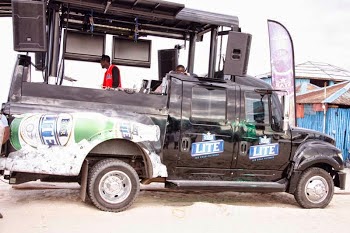
Introducing Africa's First Mobile DJ Truck


Simply referred to as 'Star Lite DJ Truck' , this mobile disk jockey with a state-of-the-art sound system can operate a 25,000 capacity filled festival/concert and it comes with an amazing lighting effect with unique aesthetics that drives home beauty at any event. Its large screens on both sides of the truck doubles also as a television and used as game consoles.

Making its first appearance at the Elegushi beach in Lekki Lagos, on Sunday 5th October 2014, during the Sallah Celebrations 'Star Lite DJ Truck' was a spectacle to behold. 

According to the Marketing Manager, Alcoholic drinks, Nigerian Breweries, Mr Tokunbo Adodo "Star Lite borne out of an increasing consumer need for a less filling beer, ensures consumers are able to enjoy the true beer refreshment and still able to make the most of every of life's moments looking good and feeling good. As part of our consumer satisfaction targets, the Star Lite DJ Truck has a bundle of exciting features that will not just make parties interesting but also bring a twist to the Lagos party life,”

Star Lite beer was introduced in February 2014 and has since remained a much sort after brand due to some spectacular features it posses such as , its 100% natural ingredients composition, special cold protection crown locks, neck foil, just to mention a few.

CU Graduates Are Hardworking With Good Work Ethics.... Exxon Mobil Engineer


Th
e quality of academic investment, coupled with exposure to innovative technology in driving sound academic excellence and building of the total man by Covenant University has been validated once more by the external context.


Mr. Moses Olaosebikan of Exxon Mobil, in a mail he sent to the Vice-Chancellor of the University, Professor Charles Ayo, recently shared his views on what he considered unique about the quality of graduates from the University.

In his analysis, the same way products of Covenant University are dominating the scholarship scheme for first class graduates initiated by the Federal Government, they are also dominating in other spheres, including that of Exxon Mobil Nigeria.

Mr. Olaosebikan made this known in a felicitation to the Chancellor of the University on his 60th birthday. He stated that apart from the first class graduates of the University being the highest in number selected in the Federal Government’s Presidential Scholarship Scheme (PRESSID), the University’s graduates are also doing great in initiatives embarked upon by Exxon Mobil.

According to him, “I heard four out of every 10 international postgraduate scholarships we recently awarded are from Covenant University. Our recent recruitment brought in a good number of Covenant University engineering graduates out of the lot that applied, and one of them, Adedeji Abe, 1st class Mechanical Engineering, was my direct report; he is an outstanding young man, very hardworking and with good work ethics.”

He declared that his organization hires only the best, through a very transparent, competitive and rigorous process that only the very best can scale through, thus giving no room for mediocre in the system.

Mr. Olaosebikan appreciated the Chancellor and the Management team of the University for the doggedness and commitment to raising new crop of leaders that would fill every facet of the nation’s economy and restore her rightful place in the comity of nations.

He commended the Chancellor for his dogged commitment to nation building. According to him, “If we just have about 500 of Dr. David Oyedepo’s personality in Nigeria, we would not be crawling as a nation.”

Acknowledgement: Covenant University, Tun Odunayo

Saturday, 4 October 2014

Belgian Embassy, Please Release My Passport


By Adebayo Waidi

Till present, I have really had no cause to travel beyond the African continent but the prospect of a seven months leadership training course in Systemic Change that involved online lectures and three physical meets including one in Brussels, Belgium was a game changer.

After the application and selection period I started gathering the documents I would require for my visa application at the Belgium embassy and also started researching about applying for a visa to Belgium. I soon stumbled on an article by Ben Ezeamalu of Premium Times titled “How the Belgian embassy in Nigeria held me hostage”. I read the article with interest and coincidentally our passports were virgin passports and the circumstances look similar.

He had hoped to attend a seminar in Brussels on the theme ‘The Common Visa Policy,’ scheduled for 16-17 June 2014. While I was hoping to attend the first physical meet of a seven month leadership training course on systemic change with the theme “Explorers Journey for Systemic Change” in Brussels 20-22 September 2014. Also, as part of the Brussels programme I would be attending the second European Citizens Summit on 23 and 24 September 2014, which is organised by the European Union Civil Society Contact Group (CSCG) with the theme “a new Europe for citizens driven by citizens” the citizens meet would discuss the “degrowth” paradigm as a potential solution for a fairer and more democratic Europe.

I ensured that no requirement for the visa application was lacking and my chances of getting a visa looked bright as it is an all paid travel; airfares, lodging, in-town transportation and feeding.

On the 18 August 2014, I was at VFS Global office in Lekki to submit my application for visa. At the submission hall, I soon noticed, as mentioned by Ben, the fact that travellers to Belgium were fewer than to the other European countries whose application for visa were also been submitted at the several boots on the long counter. While application for visa to other European countries like France had long lines of visa applicants, the total number of applicants for a Belgium visa from my position of having to submit at about 1pm that afternoon which is the closing time for submission of application for visa each day was about 8 applicants to Belgium. Really, I was not perturbed; I had submitted on time and the application had all the required items too.

Early the next morning, that’s 19 August 2014, I received a text message stating that my application for a visa had been forwarded to the Belgian embassy at Abuja. I was confident that things were going to turn out well. The organizers of the training programme had sent reading and course material online and I started reading and preparing my mind for the course.

Soon enough, it was already one week plus to the start of the training programme and I have not heard from the VFS or the embassy. In Ben’s case they had reached him to request for additional document/information but in my case all was silent. I became agitated and called the VFS office for answers they told me they were still awaiting a reply from the embassy at Abuja that we just had to keep our fingers crossed.

On Monday 15 September 2014, just five days to the programme, I called the VFS office again it was still the same answer; they then later gave me the embassy’s phone number and their email address. I called the number that day several times, it was never picked. I continued to call the same line for the next two days the line was never picked; it just rang and rang until the line disengaged. In the middle of this I had emailed my complaint to the embassy on Monday. I also mailed the organizers of the programme who then rallied round trying to see what could be done. They reported that after many phone calls and emails that they got an answer that just said “very expensive” and that matters relating to my getting a visa or not would be concluded on Thursday 18 September 2014. The organizers asked me if I knew what they meant by “very expensive” and I replied in the negative and they then advised that I should continue to try to reach the embassy and if it has to do with financial matters they were willing to intercede.

That’s how till as am writing this piece, I have not gotten any reply about my visa application and neither has my passport being returned.

The training programme has started since Saturday and other participants from over the world are there, while I have to make do with trying to catch up with them through reading here. The embassy has the right to grant or deny a visa but my concern is that they are holding unto my passport even when it is obvious they don’t intend to grant me a visa.

Furthermore, as I earlier stated the leadership training course includes three physical meets; the first being the Brussels one, the next is in Johannesburg in November during the civil society week. This year’s civil society’s week coincides with the commemoration of twenty years of the dismantling of apartheid in South Africa.

As it is, I urgently need my passport to start the application process towards taking part in the next phase of the training programme in South Africa. As such I’m using this medium to appeal to the Belgian embassy in Abuja to urgently return my passport back to me.

Adebayo Waidi is an author and President, Campaign Against Ignorance & Illiteracy, (CAII)

The Power of Unity


By Reno Omokri

The manner in which Nigeria confronted and defeated the Ebola Virus Disease (EVD) has exposed the challenge Nigeria faces in fulfilling her potential. Corruption, tribalism, religious bigotry and extremism are symptoms of the challenge we face. They are not the challenge. To understand and address the challenge Nigeria faces, we need to understand why we were able to defeat EVD.

From the first day in July 2014 when Patrick Sawyer introduced the virus to Nigeria, to the day when the World Health Organisation (WHO) declared the virus contained in Nigeria, what we saw was unity of purpose and action across the length and breadth of Nigeria. There was no finger pointing, no accusation or counter accusation. All of us, whether Peoples Democratic Party (PDP) or All Progressives Congress (APC), whether northerner or southerner, whether Christian or Muslim, whether male or female, united behind the singular objective of defeating EVD.

Being that the whole is greater than the sum of her parts, Nigeria’s unity of purpose in challenging EVD unleashed such power, such passion, such never before seen cooperation that the virus had no chance of wreaking the havoc it had wreaked in other nations. The Federal Ministry of Health set up a committee to work with the affected states. Now, the committee set up by a PDP-led federal government worked hand in glove with Lagos and Rivers States both of them governed by the opposition APC.

Information was shared and not withheld. Funds flowed freely for the federal government to these states. Daily briefings were held by Prof. Onyebuchi Chukwu, the Minister of Health, who had to rely on and trust information provided him by APC commissioners for health in Lagos and Rivers States. At the executive level, almost all the governors in Nigeria along with their commissioners for health turned up for a meeting with President Goodluck Jonathan to address the challenge of EVD on August 13th, 2014. All parties were represented, including those who had previously refused to cooperate with the federal government on important issues such as the National Conference and intra party conferences.

Governors who were hitherto at loggerheads with the president became his new best friend for life on the issue of EVD. The air of cooperation and synergy at that meeting was so contagious that together, the president and the governors came up with the ‘Ebola Handshake’ that required no touching. One after the other, these executives took turns to use hand sanitizers on national television. A paper that has the perception of being opposition leaning even carried a caption that day saying: “President Jonathan watches governor Fashola of Lagos State as he sanitizes his hands.”

Was it therefore any wonder that on the 21st of September, 2014, WHO declared EVD “contained” in Nigeria? So profound was this achievement to the world that The New York Times had as its front page leading headline on October 1st, 2014 ‘Nigeria’s Action Seems to Contain Ebola Outbreak’. To put this in perspective, it may be necessary to remind my country men and women that October 1st is our Independence Day, but The New York Times considered our defeat of Ebola more newsworthy than that! Permit me to state that if there was ever any doubt about Nigeria’s independence as a nation fully in control of her destiny and not tied to the apron strings of Britain or any other nation in the Western Hemisphere, those doubts were put to rest with our conquest of EVD.

And as if to declare the above to be true, several papers, local and international, carried the headlines that the United States (having recorded its first case of the Ebola Virus Disease on September 28th) is sending medical experts to Nigeria to learn how to contain the scourge. To me, the moral of the story is that Nigeria can overcome her national challenges if Nigerians apply the template we used in defeating Ebola, which are-unity, cooperation and multi-partisanship. President Jonathan put it best when he delivered his homily at the interdenominational service to mark Nigeria’s 54th Independence Anniversary on Sunday, September 28, 2014. He said: “The only thing is to appeal to all of us Nigerians to be united. If we are united, there is nothing we cannot conquer. Take the case of Ebola and this is a good example that all Nigerians must learn.

“When Sawyer brought Ebola to Nigeria, it was in Lagos that this incidence happened and in terms of politics, Lagos is an opposition party but the central government is the ruling party.
“From Lagos, Ebola moved to Rivers State and this is also an opposition party’s state. But because all Nigerians fought Ebola irrespective of political persuasion, irrespective of religion, or ethnicity, we defeated Ebola”.

Incidentally, as the president said those words, he was not reading from his prepared speech. He spoke extempore, he spoke from his heart. On May 27, 2014, I was featured on the back-page of THISDAY newspaper in a piece titled ‘From Battle Ground to Common Ground’ where I identified three ways of building unity. I said unity could be built amongst people who shared the same goals in which case they would be constituents. I also said unity could come amongst people who had a common enemy in which case they would be comrades. I had said and still maintain that the unity of comradeship only last as long as there was a common enemy (in this case, Ebola). I had then opined that the best type of unity is one founded on friendship.

As a pastor, I have read the Holy Bible and the Qur’an and both books talk about what happened to mankind in Babel. At Babel, all of humanity was united and spoke one language. This would have been a good thing except that the unity of humanity in Babel was a unity against God. But what is most instructive about Babel is God’s testimony about them. In Genesis 11:6 prophet Musa (as Moses is called in Islam) quoted God as saying “The people are united, and they all speak the same language. After this, nothing they set out to do will be impossible for them!” Since God spoke that word, every great nation has learnt the secret to greatness from that verse-unity.

In fact, the greatest nations have included the word ‘unity’ in their name-The United States of America, the United Kingdom, the European Union, the United Arab Emirates, etc. As Nigerians, let us learn from our experience with Ebola and move from the unity of comradeship to the unity of friends.

If we can learn to speak with one voice against Boko Haram, against corruption, against religious and ethnic clashes, we will defeat them as we defeated Ebola and the newspapers of the world will begin to carry reports on how the nations of the earth are sending experts to Nigeria to learn from us how to be a great nation. Already, we have comradeship. Let us not let this dissipate as the threat from Ebola ebbs. Rather, let us build on this and grow our unity to the unity of friendship.

When people read this, they may mistake my call for unity as a call for a one party state. Not so. We do not all have to agree to be united. But we do have to agree to disagree without being disagreeable for us to have the type of unity that leads to greatness. It is just like a choir or an orchestra. If everybody in the orchestra or choir sings in the same way, the music would not be engaging and elevating.

For a choir to move its audience, you must have the alto, the contralto, the tenor, the baritone, the base, the treble, the falsetto and the soprano. The concertmaster does not expect these varying voices to sing in one tone because that is impossible. What is expected is that they should sing in harmony. It is this harmony, this unity of purpose in blending their various voices in a complementary manner that creates the music that stirs the soul.

This is what we must do in Nigeria and by the grace of God we would use what some thought would destroy us (Ebola) as a catalyst to achieve the unity of purpose that will secure our place as one of the greatest nations on earth.

Reno Omokri is Special Assistant to the President on New Media

Friday, 3 October 2014

Pay Me The Money: Peregrino Brimah Demands $7Million Shekau Bounty From US Government


PRESS STATEMENT

On June 3rd 2013, the United States Department of State declared “Abubakar Shekau” alias, Abu Bakr Skikwa, Imam Abu Bakr Shiku, Abu Muhammad Abu Bakr Bin Muhammad Al Shakwi Al Muslimi Bishku, wanted. A bounty of $7 million was put on his head for “information on his location” or leading to his capture. Quote: “rewards for information on key leaders of terrorist organizations in West Africa.”

In February of 2014, I on behalf of the ENDS organization, released an explicit article, “Boko Haram Leader Abubakar Shekau Is Dead!” In the article, we proved with clear evidence that the new person appearing in all videos released since August of 2013 were impostors of the late Shekau I.

In May of 2014 after Boko Haram abducted 234 girls from Chibok in North-East Nigeria, we provided side-by-side picture comparisons which fully exposed the differences between the new Shekau II who released the videos and the original Shekau I declared wanted.

So many local and international media rejected our position. CNN on May 13th of 2014 denied our claims as supported by Nigerian government’s intelligence position; they wrote: “The man identifies himself as Boko Haram leader Abubakar Shekau.” Nigerian officials disputed that claim on Monday, arguing that Shekau is dead. Other experts say the notorious terror group leader is still alive.

In the same article, CNN went ahead to argue that: “The same man appears in Boko Haram videos claiming to be Shekau at least as far back as August. And at least one expert doubted Ogar’s claim.”

However shockingly erroneously, CNN compared Shekau II to an edition of him in August of 2013, after the new impostor had taken over, and did not responsibly compare the new person to editions of Shekau I between 2011 and July of 2013, which were clearly a different person.

Our accurate updated information on the whereabouts of Shekau I, derived from careful analysis of all past video and picture images of Shekau, determining authoritatively that an impostor appeared in all post August 2013 releases by Boko Haram and their affiliates, was essential and invaluable towards asserting the strength of the group, and phase of security departments in the war on terror and for determining US strategies of involvement.

Today the Nigerian government is announcing the likely killing of Boko Haram leader Shekau II. There are images of his body for careful analysis and his physical carcass genetic studies to confirm that this person is an impostor as we accurately proved.

Several experts including Australian negotiator, Stephen Davis, have now asserted and confirmed our asserted publications, that Shekau I died since July of 2013.

In light of the new evidence, we believe ENDS deserves the US reward for clarifying with detailed analysis and pictorial evidence the location of Shekau I – Dead and buried. Our press releases categorically informing the world of the impostor taking up the deposed leader’s role were essential in the fight against Boko Haram who depended on portraying the real Shekau as still alive to maintain morale, confidence and loyalty of its members.
We look forward to the initiation of the compensation process for our invaluable role.

Peregrino Brimah
ENDS

Amosun Expresses Delight at World Bank Report on Ogun


Ogun State Governor, Senator Ibikunle Amosun has expressed happiness over the World Bank Group report titled "Doing Business in Nigeria 2014" in which the state was named as "one of the top reforming states in 2014."

Amosun, who briefed members of the State Executive Council and Body of Permanent Secretaries on the report, thanked all officials of the state government for their contributions to the ongoing development in the state which had attracted the attention of the World Bank.

Ogun State, according to the report, made significant improvement as it was "one of lowest ranked overall performers in both 2008 and 2010," and now, "it is one of the top performing states in 2014."
The report stated that "Ogun improved on three of the four Doing Business indicators benchmark (as) the construction permitting system was radically overhauled, with the state government authorities decentralizing the approval system and a new committee monitoring delays."

In his briefing to top members of the government, Amosun explained that the achievement was made possible through the hard work of many Ministries, Departments and Agencies, whose officials worked tirelessly to improve on the way business is conducted in the state.

He added that the release of the report on September 29, 2014, the same day he was conferred with the national honour of the Commander of the Order of Niger (CON), made his joy very full and that he was thrilled with the report which represents an international endorsement for the ongoing Mission to Rebuild Ogun State.

The governor further enjoined members of the government to be aware that recording success could be easier to achieve but that the bigger challenge was how to sustain the success.

"We must work harder. All of us must not drop the ball. The indicators used in the report showed that we will need to work on one of them which is enforcing contracts and they used an example of a project they financed before this administration came to office.

"Let us ensure that we improve on all the indicators by the time they will produce 2016 report. This is a collective achievement and we have a joint responsibility to sustain it," he said.

Amosun noted that officials of Ogun State can now travel abroad and discuss the developments in their state at international fora and in discussions with investors, development partners and financial institutions.

He expressed hope that more investors will access the World Bank report and that will renew their confidence and interest in taking their business to Ogun State. This, he said, will lead to massive employment for our people.

"When many key opinion leaders repeatedly say it that things are getting better in Ogun State, this report is a confirmation that our efforts as government is yielding positive fruits," he said.

The World Bank report noted that Ogun State improved in the areas of issuance of building permit, involvement of professionals in the issuance of environmental impact assessment, on the spot issuance of certificate of completion immediately after inspection, easy access to stamp duty for business registration in Abeokuta by entrepreneurs, ease of obtaining business permit and the digitisation of property records with the aim of enabling electronic title searches, among others.

Thursday, 2 October 2014

The Benefits of Ebola!


The dreaded Ebola disease landed on ours shores unannounced. Before the invasion, Ebola was a reference point to an American movie released in the nineties and further reference made back to its initial discovery in the jungle of the DRC formerly known as Zaire in the mid-seventies.
With its sudden appearance in Nigeria, it caused the panic that it should naturally. Reactions to its outbreak were rather positive at the official level and not panicky. What this meant was that the authorities saw the magnitude of the problem if allowed to get out of hand and did everything possible to nip in the bud what could be termed as ''Armageddon on the horizon''. Seeing that a major emergency had broken out is key, it influenced government’s attitude positively by making the relevant levels of government more responsive.

The invasion of Ebola put to test how effectively the authorities could manage the crisis through the deployment of human and material resources to combat and eventually put the disease under proper check. The federal government through the minister of health decided to put politics aside and make the necessary liaison with his counterpart in Lagos state. A synergy of purpose ensured making it possible managing the crisis most effectively. In the process what eventually evolved was the development of professional expertise in reacting to and managing any major outbreak in the future.

The depolitisation of the emergency meant greater efficiency in the dissemination of vital information to the general public on how to prevent the possible escalation of the outbreak. There was also the need to educate the public on Ebola. At this juncture both the federal and Lagos state government saw the importance of singing from the same hymn sheet.

At the state level a robust campaign was launched and played out simultaneously through all forms media platforms namely, the press, electronic and also through social media in Lagos State.

On the part of the citizenry, individual hygiene habits seem to have changed for the better. Constant washing of hands when necessary is now observed rather than told. Moreover a more disciplined eating habit has now become part of daily living.

What makes the outbreak of Ebola to the nation beneficial is the fact that it brought to bear Nigeria’s capacity to face up to a challenge and deal with it on its own terms. The myth that the nation is incapable of managing a crisis was punctured. What the nation learnt is that patriotism has been and still is the missing link in the country’s quest of attaining its desired results. The twist of the crisis is making us more disciplined, focused and result oriented.


By Olugbenga Adebanjo (Columnist of The Unknown Nigeria)
Olugbenga Adebanjo is the Lead Consultant of Beacon 6619 Media Solutions.